Monday, March 30, 2009

Lake George Memories

The original draft of this family story was outlined one summer night in 2008 in the boat house at Brant Lake, which is just north of Lake George, owned by Prudence, the significant other of Sandy's brother Brian. The tale has been simmering ever since. I finished this story in one sitting on March 29, 2009.

The first time I saw Lake George, named after the English king of the time, I was five years old. It was 1950. The Bacon family went on vacation every single year, but it was always to Lake George. We would drive up, hauling the trailer and watching the station wagon engine temperature. Whenever Dad would stop the car, he would raise the hood to cool the engine. There was no Adirondack Northway then. It was all back roads. We went through North Adams, Williamstown and Pownal, Vermont and into New York State.

We would always stop at a kind of hot dog stand/bar on the left that had really HOT relish. Hoosac Falls? Dad liked the hot stuff. You see, that’s what I like about family stories. They wouldn't put that on a headstone, but it is cool to know. Dad’s eyes were blue, and so were my cousin Craig's. Auntie Blanche, his Mom, loved raspberries. If I didn't write that now, then no one would ever know. You can't make up stuff like this.

Looking back, I am glad that Lake George was all we did for vacations. We went there from when I was five until I was eighteen. The very first time we went, we stayed at Lake Luzerne where Dad’s best friend from childhood had a camp. Matt Kustra was a United States Navy veteran like Dad. Matt was with Dad when he met Mom for the very first time, at a roller skating rink. He served aboard the aircraft carrier Hornet, and if you know anything about World War II, you know that these sailors saw all the action that one could possibly see.


Matt Kustra in later days.

I wish that I could speak to Matt and Dad about their adventures in the South Pacific, and thank them, but they are long gone now. The greatest generation, I agree. My friend Charles likes the word "served" -- served your country, they sure did. Have you? Did you serve? Do you attend town meetings or pick up trash or coach a little league team? Really? Good for you!

All this started in 1950, and almost no one is left to say whether this is true or not, but I will tell it as I remember it for the family history. The police say eyewitnesses are often wrong, but here goes. This could be boring for you, so you can cut out now and text some one and I really won't care. My girl cousins Paula, Greta, Ruth and Leda, will vouch for what their cousin Bobby says.

We only stayed at Matt's for two years, and then moved on to knotty pine type cabins at the northern end of the 36-mile-long lake at Bolton Landing, and then next to Lake George Village at Diamond Point. But the real vacations began when we first started tent camping at Battle Ground Campground, just south of Lake George village. It is still there. We had tents. Two of them. The one my brother Mike and I slept in was sewed together by Mom and Dad in our backyard at 90 Howland Avenue in Adams, Massachusetts. Scenes are stuck in my brain with my Mom, Nora, sewing on some special sewing machine outside, in between our tiny house and the three-car cinder block garage.

My Grandfather Frank Bacon poured all these blocks in the cellar of 92 Howland Avenue. Mom said that is probably where he got the cancer, in the dampness of that stone walled cellar. It's funny what you remember, isn't it? Before Dad got a chance to pour the floor to the garage, it rained and filled the foundation. He was thrilled. Now all he had to do was mark the height of the water and he would have a perfectly flat garage floor. Dad wasn't afraid to tackle anything or anybody -- from a North Adams, Drury High School half back, to the repair of a fifth wheel on one of Rene Comea's tractor trailers, or to putting a slate roof on the two story BIG house where Grampa and Gramma Bacon lived, ten feet away from our tiny doll house that Mom kept.

I remember my brother’s and my tent as being fairly unbreathable, but solid and rainproof. The tent had no windows. The beds had wool blankets, probably from some Army/Navy store. They were white with a big blue stripe. Are there still real Army/Navy stores? One day it did rain, and we went shopping to Glens Falls. Mom bought me a book written by Audie Murphy, the Medal of Honor winner from WWII. It was called To Hell and Back. I read it in our tent in one night. It was the very first book I ever read.


Nora Bacon at the Million Dollar Beach, Lake George.

In between the two tents was the trailer that Dad built – parked, the wheels chocked -- that held everything that we would need for the two or three weeks that we were at Lake George. It doubled as a food storage area. We never ate out -- Mom was a great cook. We had metal bed frames that folded up (but the mattresses were very comfortable) with real pillows. Dad and Mom called the trailer the "Chuck Wagon," because it was connected to the two tents with a tarpaulin (a piece of waterproof canvas used for protecting exposed objects) that kept all three tents dry and cozy, with a picnic table and fireplace in the middle --and it held all the food. So it did not really matter whether it rained or not. It rarely did rain as I remember.

Dad showed us all the knots to tie the tents and the tarpaulin down -- he had learned them in the Navy SeaBees -- and of course we had to dig all the trenches for the rainwater to run off and away from the compound. And to collect firewood. Vendors would come through, selling ice and vegetables. There was no electricity.

If you drive through the Battle Ground Campground this summer you will see what I mean. Everything looks smaller now, but if you allow me, I will show you every single tent site that we stayed at. But why bother -- you won't come. People from Boston have never even heard of Lake George. They want to just go to the Cape and eat chowdah. We don't want you and your Red Sox Nation hats there any way. Mostly the tourists here are from New York or New Jersey or Can-ah-dah. Aye!

Battle Ground Campground has that name because of all the history that has happened right here. Hawkeye and the Last of the Mohicans, the French and Indian War and the Revolutionary War. Montcalm, Forts William Henry and Ticonderoga, The Green Mountain Boys, Rogers’ Rangers, Bloody Brook, Forts Edward and Ann. Nearby Saratoga, the battlefield not the horse racing stadium or the springs or the spa. I guess this is why I am a history fanatic -- but at least I am not a shopaholic or a serial killer. Okay, so I am a little bit of a shopaholic, but I got it from Mom and her sisters of the Hoosac Valley, who made it a team sport. Maggie Risley, from Pittsfield and a true Navy friend for 44 years, is one but she's still a good person. You make it sound like it is a bad thing.


This statue of a Mohawk and Colonist was inside the campground.

It drives Sandy crazy when I say that the Bacon Family was there before Fort William Henry, but we were. Sort of. Well, let me explain. The French and especially the Indians burned down the original fort, just like in the movie Last of the Mohicans, but it was rebuilt during the years that we vacationed there. Get it?

The Breens ran the Battle Ground Park, along with their two daughters, who we kind of pined over, but Mr. Breen kept them working and away from the wild Massachusetts boys. For laughs we would go to the outhouses and move the mixer pipe back and forth and holler out, "Help me, I'm drowning!" Okay, so maybe you had to be there, but it was very funny at the time. No, there were no toilets in the tent. Jeez. City people. Come to think of it, there weren't any showers . . . hmmm. There was no electricity, so we had to use white gas lanterns that you had to pump up before you lit.

When we were really young, my brother and I dug a four foot hole at the entrance to our campsite, and covered over with branches and pine needles to catch raccoons -- but we caught two pretty Canadian girls instead. Mom, Dad, Why did you let us do that? Our parents held, as Grandfather Frank said, very loose reins on us. Grampa also used to say, "If we didn't knock it off he would put tin ears on us." He had the very same composure that our friend Allan Sylvester has. You know what I mean -- you would have liked him right away.

The fifties brought the music of the Everly Brothers, Frankie Avalon, Chubby Checker, Bobby Rydell, Fabian Forte, Buddy Holly and Fats Domino.

Let's twist again
Like we did last summer
Let's twist again
Like we did last year

("Let's Twist Again" was actually a bigger hit than its predecessor from a year earlier, "The Twist.")

Someone would find a guitar and we would all sit around the campfires and sing and toast marshmallows and do drugs. Only kidding -- the only drugs were rye whiskey and beer, and I do not remember anyone, even Dad , overdoing it.

We never used the car, except for Grand Union grocery shopping. We would walk to the village to swim, or to wander at night, or go for ice cream, play shuffle board, or miniature golf. Yah, the Grand Union still stands -- and with most of the same staff. Only kidding. It seemed like a long way to walk to town then, but it really isn't. At first we would swim at the Million Dollar Beach at the south end of the lake, but soon we became regulars at the town pier near the Jolly Roger with all the other regulars to Lake George. Handsome John was the lifeguard at the town pier. He was muscular and always wore sunglasses. His nose was always coverd in white zinc oxide, to protect it from the sun. He always gave us a great Welcome Back. I still have a two-inch gash in my right foot that I got from landing on broken glass, jumping off the pier there. Mom taped it together and told me it was fine. Today I would have needed seven stitches and therapy. I tell young people that I got the wound at the battle of Gettysburg.

Lake George is a fairly cool-temperature lake, being thirty six miles long and four hundred feet deep. Paddlewheel boats that you see on the mighty Mississippi still carry passengers from one end to the other, but now they are diesel and not coal- or wood-burning. There are many boats on the lake, mostly power boats. There are many islands that you can camp on. Tom and Jeanette Egan and family have done it for years. Tom was born and raised in Providence -- it is in Rhode Island - and visited here as much as I ever did when he was young. This is only one of the things we have in common that holds our friendship together.


A paddlewheel boat on Lake George

Folks from the Italian section of our hometown would come up, mostly at exactly the same time. The Volpes, Demastris, Ballardinis and Bianchis. I don't actually remember them being there, but I have photos to prove that my grandparents, Frank and Hattie Bacon, were there, as well as my grandfather’s brother, Uncle George, his wife Georgina, and all my girl cousins -- plus their mothers, my father’s sisters, Cyrella and Dorothy.


Hattie and Frank Bacon.


Left to right: Dorothy Gotzens, Greta Gotzens, Paula Gotzens, Nora Bacon, Turk Gotzens, Bob Bacon, Hattie Bacon, Francis Bacon


My Uncle George Washington Bacon and Aunt Georgina at Campsite 31. Uncle George retired in 1955 and traveled extensively all over the US, Mexico and South America in his trailer (shown in photo at right).


My cousins, the Gotzens girls, Greta, Ruth, Paula, and Leda.

My childhood friend Bucky Volpe is already gone, but his mom, Gertrude, is still living in Adams. Monsuelo Ballardini’s wife, my Mom's best friend, Betty passed away in 2008. Now my cousins and I are the only ones left to tell the story. I swear this is all true. I would never lie to you mi amor.


Bucky Volpe

Thank you, Mom and Dad. Sometimes I go down to Lake George Village by myself when I am at Brant Lake and think of you both and of those wonderful, carefree times. The park near the town pier still looks the same. They still have free concerts there. Recently Sandy and I saw Gino Delafose from Louisiana play Zydeco music there. The Million Dollar Beach is worth ten million now. Fort William Henry still shoots off her cannon now and then. Yah, they still have the fireworks. There is a really good Polish restaurant on General Montcalm Avenue. Can you believe it? I actually feel closer to you there than when I am in Adams, near our house on Howland Avenue or at the Bellevue cemetery. I know you would be tickled to know that Sandy and I still visit -- and it all started with our family vacations so long ago. Yup, the girls come too. Abel hasn't been yet. Oh, I forgot, he is your great grandson. He is Kezia and Chris's son. He looks just like Kezia but somehow he has Dad's blue eyes.

There was an old TV show that said at the end, "Thanks for the memories" and that is how I feel.

Love,
Bobby

Monday, March 23, 2009

A 'Steve Riley Happening' on Isla Mujeres!

It was our last full day on Isla Mujeres, Mexico until next year.


We had just come off the Playa Norte and were turning in our beach towels at the front desk of Maria Del Mar (Cabanas). It was another perfect day of sunning and floating and salty margaritas in the Windex-colored water. Well, you've been there so you know! What, you haven't been yet?

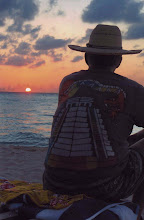
Sandy was wearing a pareo over her bathing suit, her sombrero, and on top, her amarillo "Bob's 60th" tee shirt. Do you remember it? On the back it says "Steve Riley and the Mamou Playboys" and "Lil Anne & Hot Cayenne."


It is hard for me to believe that tee shirt will be four years old this July.

All of a sudden this couple walked in, spied the names on the back of Sandy's shirt, and both started talking a mile a minute. "How do you know Steve Riley? What a great band! Do you go to New Orleans? Have you been to Mulate's, Michelle's, Haven Brothers, the Maple Leaf, Tipitina's, the Rock and Bowl, Mamou, Baton Rouge, Lake Charles, Church Point, Lafayette, the Mardi Gras?"

Charles and Cactus Cathy, our friends from Albuquerque, were wearing their tee shirts in Tucson when just about the same thing happened to them. A couple originally from New England -- but now living in Arizona -- said that they love the music and really, really missed the Cajun/Zydeco dance scene.

Our new Isla friends were from Dallas -- it's in Texas. I think. They have been to Mexico a million times but Isla is their favorite place to go. "Did we know of the Pine Leaf Boys?" They happen to be Sandy's second favorite Cajun Band. At his 60th they had the Pine Leaf Boys come to play. Holy Frogs! Where have I heard this story before?

We mentioned that we were seeing Steve and the Playboys at Johnny D's in Boston the very next Thursday night


and then again Saturday night, along with the Creole Cowboys (Boozoo Chavis doubles) and C.J.Chenier, Clifton's son, at the Mardi Gras Ball in Rhode Island.

Steve Riley asked "Did you get their names?" NO! And they didn't ask for (or get) ours.

You just don't think about these things when you are in the middle of a STEVE RILEY HAPPENING.


Sincerely,
Roberto Tocino
Mayor of La Isla Mujeres
(I was a write-in on the ballot.)

Monday, March 2, 2009

A Short Story About A Small Town


Jimmy Zabek, his real name was Adolph, was Sandy's father. He died when Sandy was six months pregnant with Kezia. I basically typed this up for Kezia for the family tree. The following was a little article in the North Adams Transcript. Cioci Florence sent this news clipping to Sandy and I today.


Jimmy Zabek, who died Sunday while playing golf at the Forest Park Country Club, a friend for many years, was a member of the crack St. Stanislaus basketball team that won the Polish National Alliance tournament, held at Adams in 1949, defeating St. Peter and Paul of Chicago, 54 - 49 in the final at the C.T. Plunkett Junior High gym. Others on the team were Jimmy's brother Chester, Stan Senecki, Mike McAndrews, Eddie Anton, Bushy Nowak, Johnny Zaloga, Chester Menczywor, and Johnny Jasinski.

Chester was my high school football coach in 1960. Stan Senecki dated my mother’s sister Stephie, who never married, for several years. Rumor was he was a heavy gambler. I have a photograph of him looking very dapper.


Mike McAndrews opened an insurance company in Adams that still exists. Chester Menczywor married Sandy's Cioci Cecelia, who just passed away last month.

This was all after World War Two. All nine men were United States Navy sailors.

Do things still go on like this in small towns in the United States? I hope so.


Frances & Jimmy Zabek on their wedding day, with St. Stanislaus Kostka Church in the background.


A billboard in Adams, MA. St. Stan's was recently closed. Parishioners are maintaining a 24-hour vigil/occupation of the church.

Tuesday, January 6, 2009

The Vermont 100-mile Endurance Run, 1990


Hey, I was up for 40 hours at this point! Brian did a great job crewing and he knows it.
I slept in the sun room on the night after the race. John Stewart said, "You must sleep soundly after a 24-hour run." I said, "You feel like you have been in a car wreck."


I WON'T FORGET: VERMONT 100, 1990

Pinky: A volunteer at an aid station in the middle of nowhere handing out her homemade brownies.

A Young Man: the volunteer I saw so many times at various aid stations. He must have been up for two days straight – Did I mention that he only had one leg?

Young Girls: on the horse farm, the start and finish points of the race, who live and breathe horses.

Bob: who was told by a doctor not to run until his eye surgery healed – so he walked 88 miles. You are awesome.

Bev: who had a couple of nasty falls and still finished under 30 hours. Her grandchildren will be proud.

Ross: the 60-something dentist from Oklahoma who blew by me at 93 miles. I forgot to tell you that I admire you.

Dale: from San Diego. On your advice to a rookie on how to run 100 – “start off fast” – Are you sure?

Brian: my handler; who, for 30 hours supplied me with socks, pizza, sunglasses, etc. and an immense diary of notes.

Linda: whom I met at her first 50 in Maine. She’s already a Western States 100 veteran. It was so nice to see your smiling face again.

Medical Volunteers: How many times did you have to say “What was your weight when you checked in?” I forgot to thank you.

Jack: my new running friend. We had some 60 miles of conversation. It’s good to know you.

The Gentleman Who Rode Arabelle: I hope I have your zest for life when I am your age.

California Group and Groupies: I knew from looking at them that they weren’t from New England. They had a lot of fun. I’ve never seen the wave done anywhere besides at ballgames! Please come back again.

The Young Woman Who Came in Second, and Her New Husband/Handler: I say “new” because they were on their honeymoon – honest!

Laura: The State of Vermont’s Ambassador. A salute to you, your caring volunteers, and your beautiful state. It was a wonderful race. Thank you so much for the most exciting weekend of my summer.

The Trail: covered bridges, fresh air, blue sky, green Green Mountains, trickling brooks, dirt roads, horses running free, warm sun, the Northern Lights.

Those green marker lights, Ten Bear Camp, my flashlight dying at 10:30 PM in the middle of the woods, the taste of Coca-Cola (but not for a while).

They say that the course is so well marked (and it is) that Stevie Wonder couldn’t get lost. But I did – twice!

The last leg is 3.2 miles? No way, Laura!

By Bob Bacon

Bob Bacon, 45, from Marshfield, Massachusetts, finished the 1990 Vermont 100-mile Endurance Ride and Run; it was his first (completed) 100.

NOTE: PLEASE CONTINUE READING. THE COMMENTS BELOW ARE ALSO RELEVANT TO THE STORY!

Friday, November 28, 2008

Como se llama? (What is your name?)


A Hungpapa or Unkpapa Sioux baby is born on the plains of Montana territory. His mother and grandmother name him Rain in the Face. Because it is raining and the rain is hitting his face.

RAIN IN THE FACE


Many of my best friends are named for their fathers. Tom Jr., Tom Jr., Norman Jr., Gordon Jr., Charles Jr. I was close -- Mom and Dad used my Dad’s first name as my middle name. Remember the movie “Little Big Man?” He was a real Indian, the son of Big Man. In my neighborhood I was Big Bobby. Bobby Gamache was little Bobby. I wish they would have used Indian names such as White Man Runs Him or Two Moons or Crazy Horse or He Dog or Two Whistles or Goes Ahead or Chief Coming Up or Chased By Owls. My brother-in-law Brian probably would prefer Spotted Eagle. If you are a runner, then you remember the first -- and best -- running store in Hanover. It was called The Runnery, and the owner was a white man named Sharpless Jones.Today he probably is on Barak Obama’s staff.

1876. Rain in The Face fights at Little Bighorn. The Indians call it the fight of the Greasy Grass. He slays Tom Custer, George’s brother, during the fight. Sitting Bull joins Buffalo Bill Cody’s Wild West Show, which tours Europe with sellout crowds in England, France and Germany. While in Chicago, Rain In The Face attends the 1893 World’s Fair and takes a ride on the world’s first Ferris Wheel. And you want me to read a book with a story that someone made up?

BUFFALO BILL'S WILD WEST SHOW


The Greasy Grass Fight, Custer’s Last Stand or the Battle of the Little Bighorn, June 1876. Our country is only 100 years old. In formation, they charged across a broad and open flood-plain just west of the river called the Little Bighorn. A line of men on horses headed directly for the southern end of the encampment of nearly a thousand lodges and eight thousand people. At some point in the headlong gallop, the attacking soldiers opened fire. Blasts of gunfire shattered the relative stillness of the hot afternoon.

SIOUX TEEPEES


Bullets from the first scattered volleys easily reached the camp. Their first kills were not combatants, however. Two women and a girl were the first casualties of the Battle of the Little Bighorn. They happened to be the wives and daughter of a capable and respected battle leader among the Hunkpapa Lakota, named Gall.

GALL


Their deaths would motivate him to “fight like a wounded bear.” In battle he would only fight with a hatchet.


He fought the battle with white stripes painted on his arms and split many heads with his hatchet. “I killed a great many,” he said. Elizabeth Bacon Custer said “Painfull as it is for me to look upon the pictured face of an Indian, I never in my life dreamed there could be in all the tribes so fine a specimen of a warrior as Gall.” He was Sitting Bull’s adopted brother. Gall died on George Custer’s birth date. Okay, okay, I give up. Give me your fiction book.

In his book, “My Life on the Plains,” Custer reproduced a telegram from Sherman to President U.S. Grant which says in part, “We must act with vindictive earnestness against the Sioux, even to their extermination, men women and children. Nothing less will reach the root of the case.”


Last photo of George Armstrong Custer leaving for Custer’s Last Stand. Just the name alone should have tipped him off to what was about to happen.

Crazy Horse. NO photo ever taken. It was said he did not want to lose himself inside the white man’s box. His exploits as a fighting man drew other fighting men to him. His individual achievements came early. Consequently, he became a combat leader as a very young man, reaching that status sooner than any of his predecessors. He frequently exhibited opposite sides of his persona as a warrior. On one hand he was reckless to a fault, seemingly taunting death. On the other hand he was capable of staying unwaveringly calm in stressful situations. Riding with him into battle, warriors knew that any man who was injured or killed would not be left on the battlefield. Away from the battlefield, Crazy Horse was a quiet and contemplative young man. He had a lifelong habit of taking care of elderly people first. Whenever he hunted, before he took meat to his own family, he made sure the elderly had enough to eat. And he influenced others to do the same.

Sitting Bull, the Hunkpapa Sioux who brought all these tribes together, had sixty-three battle coups. He became one of only two sash-wearers in the Strong Hearts warrior society, a distinction that entitled him to wear a buffalo horn bonnet covered with crow feathers, his mark of office being a strip of wool long enough to drag the ground. This trailing sash was more than decorative: when a sash wearer took a stand in battle, he pinned it to the earth with a lance, signifying that he would never retreat.

SITTING BULL


Most plains Indians could put an arrow entirely through a buffalo.


The most powerful Colt revolver would not send a ball through a buffalo. Scout George Catlin watched a Manden shoot so fast that an eighth arrow was en route before the first one hit the ground. A typical warrior could fire fifteen to twenty arrows per minute.

Rain in The Face had been invited to a feast. The guests were eating when they heard bluecoat guns, which did not sound like their own. Rain habitually carried a stone-headed war club, even to parties, but he rushed back to his lodge for a gun, his bow, and a quiver of arrows. Then he hopped on his pony and was about to ride south when he and his friends saw troops on the eastern ridge. While riding against these troops, they discovered a young woman – Tashenanini, Moving Robe – riding with them. Her brother had been killed during the fight with General Crook and now she was holding her brother’s war staff above her head at the Greasy Grass fight.

In the battle, White Elk wore a famous headdress designed by his uncle – the brow embellished with dragonflies and butterflies. Sun Bear’s bonnet was rudimentary and violent: a single horn projecting from his forehead. Wooden Leg wore a cloth shirt, beaded moccasins, and a pair of britches given to him by a Sioux. A blue-black charcoal circle enclosed his face, the interior colored red and yellow – a design never to be altered.

Sioux warriors who were first to touch an enemy could wear a golden eagle feather upright. The next wore an eagle feather tilted to the left, the next wore a feather horizontally, while the fourth might wear a buzzard’s feather dangling. A warrior who saved a friend’s life might display a cross on his clothes. A double cross if the rescue was accomplished on horseback.

LITTLE WOLF And DULL KNIFE
(Little wolf has crosses on him.) Little Wolf and Dull Knife, Northern Cheyenne chiefs 1828-1904 & 1810-1883. A rare photograph of the two most important Cheyennes.

The prowess of Little Wolf as a warrior is evident by the numerous enemy scalps displayed on his shirt. Both fought at Little Bighorn. Killing an enemy hand to hand entitled the victor to paint a red hand on his clothing his horse or his war shield.


CROW KING


Crow King, Hunkpapa Sioux, who at the Little Bighorn was the first to reach Medicine Tail Coulee from the south with eighty men, becoming the first to pursue Custer’s five companies up the long slope. At the end of the Indian wars, he was one of the last to give up. After turning in his weapons, he asked a Chicago Times reporter for two dollars so he could buy dolls for his daughters. Died in 1884.

SPOTTED EAGLE


Spotted Eagle was a Sans Arc Sioux Chief noted for his battlefield prowess and leadership. Photo is from 1880, four years after the Greasy Grass Fight.

HIGH HORSE

High Horse, Brule Sioux Chief, 1852-1931. Fought at Little Bighorn when he was thirteen.

FLYING PIPE

Flying Pipe, Yankton Sioux, fought at Little Bighorn.

FOOL BULL

Fool Bull, 1844 -1909. Was a participant at Little Bighorn at age eleven. Shown here with his war shield of shrunken buffalo hide, which is presently on display at the Sioux Indian Museum in Rapid City South Dakota.

BOB BACON

In his favorite Indian store, “Prairie Edge “ (art of the Lakota), Rapid City, South Dakota.


HE DOG

He Dog, Oglala Sioux. Nephew of Red Cloud, who fought at Little Bighorn and Slim Buttes.

YELLOW HAWK

Yellow Hawk, Sioux, North Dakota.

RED HORSE

Red Horse, Miniconjou Sioux warrior. Drew photos of the battle on ledgerbooks taken at Little Bighorn.


CUSTER'S BATTLE FLAG


LITTLE BIGHORN BATTLEFIELD


CUSTER'S BUGLE

Custer traveled with 80 some dogs and a whole Army marching band who rode white horses. Only four dogs came to The Last Stand. George and Libbie Custer had a porcupine that slept in the same bed as them. On the plains pronghorn antelope would come right up to Custer and nuzzle him to pet them. The old fur traders couldn't believe their eyes. When the 7th would leave a fort for battle, the band would strike up “Gerry Owen,” an old Irish tune. The 7th was only one-third American-born, mostly 5' 8" and under, and young -- 19- 24 years of age average. WELL they were cavalry. Did you want them to be football lineman size? Speaking of .... The head musicians name was Vinatieri, and until fairly recently his great, great, great grandson was the kicker for the New England Patriots. You can't make up stuff like this. I am not lying to you Mi Amore, I would NEVER lie to YOU. P. S.Fiction is dead.

WILD HORSE

Wild Horse, Oglala Sioux Chief, cousin or brother of Crazy Horse, of whom no documented photograph is known.

AMERICAN HORSE

American Horse, Oglala Sioux, 1898.

LITTLE HORSE

Little Horse, Oglala Sioux, 1899.

LITTLE BIG MAN

Little Big Man, Oglala Sioux, 1877.

LONG SOLDIER

Long Soldier, Hunkpapa Sioux, 1874.

RED ARMED PANTHER

Red Armed Panther, Cheyenne, 1879.

TWO STRIKE

Two Strike, Brule Sioux, 1875.

TOUCH THE CLOUDS

Touch The Clouds, Miniconjou Sioux, 1877.

COMES OUT HOLY

Comes Out Holy, Oglala Sioux, 1904.

SCORCHED LIGHTNING

Scorched Lightning, Miniconjou Sioux, 1880.

SHORT BULL

Short Bull, Brule Sioux.

BULL'S GHOST

Bull Ghost, Yankton Sioux, 1872.

ONE BULL

One Bull (Tatanka Wanjila), Hunkpapa Sioux warrior, born 1853. He was thirteen at Little Bighorn and wore his uncle Sitting Bull’s shield there. He stood next to Sitting Bull after his surrender in 1881. Taken at Fort Randall, Dakota Territory, 1882.

SLOW BULL

Slow Bull, Oglala Sioux,1907 (Edward S. Curtis)

KICKING BEAR and SHORT BULL

Miniconjou and Brule Sioux, 1891.

MEDICINE BEAR

Medicine Bear, Cut Head Dakota, 1872.

BEAR'S RIB

Bear's Rib, Hunkpapa Sioux, 1872.

HOLLOW HORN BEAR

Hollow Horn Bear, Brule Sioux, 1900.

KICKING BEAR

Kicking Bear, Miniconjou Sioux, 1896.

RUNNING ANTELOPE

Running Antelope, Hunkpapa Sioux, 1872.

OGLALA WAR PARTY

Oglala War Party, Teton Sioux, 1907 (Edward S. Curtis)

WOLF ROBE

Wolf Robe, Southern Cheyenne, 1898.

YOUNG CROW WARRIOR

Young Crow Warrior, 1912.

LOW DOG

Low Dog, Ogalala Sioux, born 1846. Became a war chief at age fourteen. Low Dog’s account of the battle is one of history’s best known.

BLACK TONGUE

Black Tongue, Cheyenne. As allies of the Sioux, the Cheyenne fought against Custer at the Little Big Horn. Photo: Niobrara, Nebraska, 1878.

TWO MOONS

Two Moons, Cheyenne, standing six foot, four inches. He is best remembered for his courageous exploits as one of the nine warrior chiefs who defeated the 7th Cavalry at the Battle of Little Bighorn. He is credited as being the only Cheyenne to have carried a repeating rifle during the battle. In February of 1876 he was camped on the Yellowstone River on his way to the reservation when he was attacked by soldiers during a snow storm. Because of that, he joined Sitting Bull’s band. Photo by Edward S. Curtis, 1910.

CUSTER'S CROW SCOUTS

Custer's Crow Scouts at Little Bighorn. White Man Runs Him, Moccasin, Curley and Goes Ahead. The 7th cavalry had 51 scouts made from six Indian tribes. Curly was Custer’s very favorite.

CURLEY

Just west of the Buffalo Bill Museum in Cody, Wyoming stands the original log cabin built for Curly by the United States Army.

CURLEY'S CABIN


The site where it is, is called Trail Town.

TRAIL TOWN


At Custer’s Last Stand, not one rider survived, military or civilian. George’s brothers Tom and Boston were killed, as well as his brother-in-law. Custer’s four Crow scouts all withdrew when Custer gave permission. They had been employed to find the enemy, which they had done. Many troopers horses were taken by the warriors, as well as scalps, clothing, weapons and much green paper with writing on it. Only Comanche, the badly wounded horse of Captain Myles Keogh, was left. Comanche was a 15–hand gelding of mustang and Morgan breeding who ran with a wild horse band that was rounded up and sold to the U.S. Cavalry in St. Lewis, April 1868. Comanche was brought back to good health and no one was allowed to ride the gelding for the remainder of its life.

COMANCHE


Depending on who was counting, 256 men of Custer’s 7th died and only 42 Indians. Their names: Lame Whiteman, Hump Nose, Open Belley, Noisey Walking, Whirlwind, Red Horn Buffalo, Black Cloud, Left Hand, Owns Red Horse, Flying By, Limber Bones, Closed Hand, Black Moon, Young Black Moon, High Eagle, Bear With Horns, Guts, Flying Charge, Hawk Man, Red Face, Swift Cloud, Mustache, White Buffalo, Rectum, Swift Bear, Many Lice, White Buffalo Bull, Dog With Horns, Dogs Backbone, Bear With Horns, Swift Bear, Three Bears, Bad Light Hair, Elk Standing On Top, Cloud Man, Elk Standing High, Deed, Eagle Hat, Kills Him, Chased By Owls, Young Bear and Long Road.


The last two Indian living participants were Sitting Bull’s deaf mute son John, who died in May of 1955. The last witness, not a participant, probably was a Cheyenne named Charles Sitting Man, who lived until 1961.

This story is 99.99% fiction-free.

Bob (Moccasin Breath) Bacon


Books read and then reread as follows. Son of the Morning Star G.A. Custer , Bury My Heart at Wounded Knee. Red Cloud and Crazy Horse, I Rode with Custer , Black Elk Speaks , My Life on the Plains ( G.A. Custer). Down the River , Edward Abbey , The Day the World Ended ( Little Big Horn ), Buffalo Bill's America and Blood and Thunder ( settling of the West ). OK Ed Abbey had nothing to do with it but I thought I would mention him any way.

The Twenty Volumes, The North American Indians, took over two decades for Edward Sheriff Curtis (1868-1952) to complete. He visited 80 tribes from Mexico to Alaska taking over 2,200 photos recording the last living traditions of North American Indians.

FROM 2005