Showing posts with label Nathaniel Philbrick. Show all posts

Friday, December 23, 2011

In The Heart of the Sea

I have been holding off reading "In the Heart of the Sea" by, of course, Nathaniel Philbrick. I thought that it would start off positively and then go downhill from there so I stalled by reading some other books first.

The first one was about a couple who fix up a house, a castle really, in the western end of Sicily.

Next was a biography of A.P. Hill, a Confederate General from Alabama who had a major role at Gettysburg.

Numero tres was a book about Edward Sheriff Curtis, who photographed all the Indian tribes in the West. The book set was financed by J.P. Morgan, all because of President Teddy Roosevelt’s backing.

Curtis spent a lot of time in Canyon de Chelly with the Navajo, and at the three mesas in Arizona with the Hopi. He personally interviewed and took photos of three very famous chiefs: Red Cloud, Geronimo and Chief Joseph. He rode with three of Custer's scouts to the Little Big Horn: White Man Runs Him, Goes Ahead, and Hairy Moccasin. At the start of the book there is a glorious photo of Curtis with six Indians.


No one knows who the Indians are, or for that matter where the photo was taken. Curtis is the white man. My guess is that it was taken at Glacier National Park. It could also be the Tetons, but these Indians are dressed more like Blackfeet or Sioux. I own a deerskin Sioux warrior shirt very much like the ones they are wearing.

And then last night I started In The Heart of the Sea. OMG! I am only on page 12. Of course the story of the ship Essex inspired the climatic scene of "Moby Dick." Moby Dick was written on Holmes Road in Pittsfield Massachusetts, about one hundred and fifty miles inland, by Leonard Cohen I think.


Page xii
He soon realized that it was a whaleboat -- double ended and about twenty five feet long -- but a whale boat unlike anything he had ever seen. The boat’s sides had been built up by about half a foot. Two makeshift masts had been rigged, transforming the rowing vessel into a rudimentary schooner. The sails -- stiff with salt and bleached by the sun -- had clearly pulled the boat along for many, many miles. Coffin could see no one at the steering oar. He turned to the man at the Dauphin's wheel and ordered, " Hard to helm."

Under Captain Coffin's watchful eye, the helmsman brought the ship as close as possible to the derelict craft. Even thought their momentum quickly swept them past it, the brief seconds during which the ship loomed over the open boat presented a sight that would stay with the crew the rest of their lives.

First they saw the bones -- human bones -- littering the thwarts and floor boards, as if the whaleboat were the seagoing lair of a ferocious man eating beast. Then they saw two men.

Tom and Eileen know all this because they lent me the book. But did they know that Captain Coffin had a daughter in Nantucket named Kezia?

Thanks to Tom Egan we all read Philbrick’s "Mayflower" and then "The Last Stand," about the Little Big Horn. Only twelve pages into this book about the whaler ship Essex of the island of Nantucket and already I am captivated.

Second Mate
Robert Bacon


Wednesday, July 28, 2010

Custer's Luck

For Fathers Day Kezia got me "The Last Stand." It is the story of the Battle of the Little Bighorn. I am currently reading it down in the casita behind the pool every night.


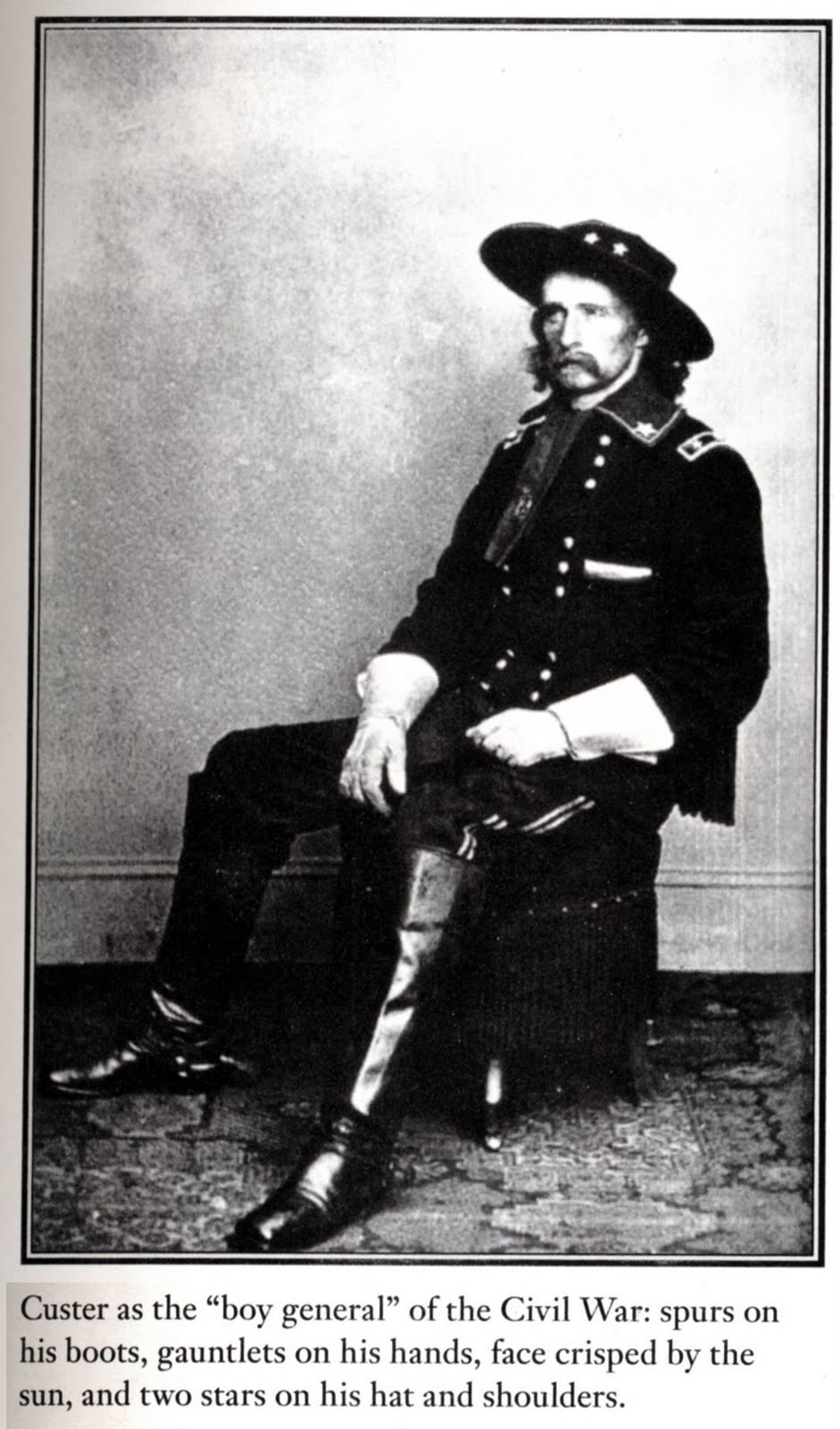
On George Armstrong Custer, Mr. Philbrick wrote:

His rise was meteoric. He started the war in the summer of 1861 as a second lieutenant; by July 3, 1863, just two years later, he was a freshly minted twenty- three -year-old brigadier general at the last, climactic day of the Battle of Gettysburg. As Confederate general George Pickett mounted his famous charge against the Union forces, a lesser- known confrontation occurred on the other side of the battlefield. The redoubtable Jeb Stuart launched a desperate attempt to penetrate the rear of the Union line. If he could smash through Federal resistance, he might meet up with Pickett's forces and secure a spectacular victory for General Lee.

As it turned out, all Stuart had to do was punch his way through a vastly outnumbered regiment from Michigan and victory was his. But as the Confederates bore down on their northern counterparts (who were outnumbered by four to one), an event occurred that changed the course of the battle and arguably, the war.

Custer, dressed in an almost comical black velvet uniform of his own design that featured gaudy coils of gold lace , galloped to the head of the First Michigan and assumed command. Well ahead of his troops, with his sword raised, he turned toward his men and shouted, " Come on, you Wolverines!" With Custer in the lead, the Michiganders started out at a trot but were soon galloping, "every man yelling like a demon.


When Custer's and Stuart's forces collided on what is now called East Cavalry Field, the sound reminded one of the participants of the thunderous crash of a giant falling tree. "Many of the horses were turned end over end and crushed their riders beneath them," a cavalryman remembered. The bodies of some of the combatants were later found "pinned to each other by tightly-clenched sabers driven through their bodies." Custer's horse was shot out from underneath him, but he quickly found another mount and was back in the fray.

Soon the Federals had the enemy on the run. As one Union officer later commented, it had been "the most gallant charge of the war." But for Custer, it was just the beginning of a long string of spectacular victories that ultimately prompted General Philip Sheridan to award Libbie Custer the table on which Grant and Lee signed the surrender at Appomattox. Included with the gift was a note: "Permit me to say, Madam, that there is scarcely an individual in our service who has contributed more to bring this desirable result than your gallant husband."


My good friends Tom Egan and Allan Sylvester were at Yellowstone this past week. They just called me from Montana today at four PM. They had stopped at the Little Big Horn. A Cheyenne had just given them his side of the story of the battle. They both sounded very excited. Their cell phone call certainly made my day.

Check out my story on my blog called "Como Se Llama," and even better yet, buy Philbrick’s latest book, "The Last Stand." You thought that you knew everything about the Pilgrims but then you read his book "The Mayflower" and were flabbergasted. He was a finalist for the Pulitzer and he also made the New York Times ten best books of the year with Mayflower. Well I think he is doing it again. Did you know that he has lived in Nantucket since 1986? He came to the 1699 Winslow house for a reading and book signing here in Marshfield a couple of years ago. It was standing room only with twice the number of people turned away. The Cerris, Sylvesters , Donovans and Bacons attended and had their Mayflower books signed. That was a very good day also.